If you’ve recently looked at cannabis product labels or browsed a licensed cannabis retailer, you may have noticed the abbreviation THCA. While most consumers are familiar with THC, THCA is less widely understood, even though it plays an important role in the cannabis plant.
So, what exactly is THCA, and how does it relate to THC? In this guide, we’ll explain what THCA is, how it forms, what happens when cannabis is heated, and why understanding THCA can help you better interpret cannabis product labels.
What Is THCA?
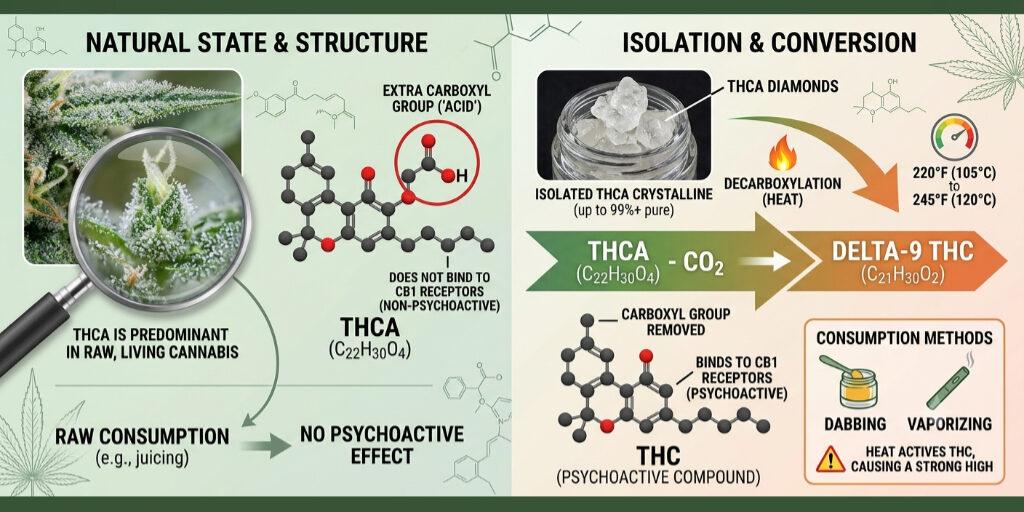
 THCA stands for tetrahydrocannabinolic acid. It is one of the naturally occurring cannabinoids found in fresh cannabis plants and serves as the precursor to THC (tetrahydrocannabinol).
In freshly harvested cannabis, cannabinoids exist primarily in their acidic forms. This means that instead of containing large amounts of THC, fresh cannabis contains mostly THCA.
As cannabis is exposed to heat over time, THCA undergoes a natural chemical process that converts it into THC.
How Is THCA Different from THC?
Although THCA and THC are closely related, they are different cannabinoids.
| THCA | THC |
|---|---|
| Occurs naturally in fresh cannabis | Forms after THCA is heated |
| Acidic cannabinoid | Neutral cannabinoid |
| Found in raw flower | Commonly measured on finished cannabis products |
The key difference is that THCA becomes THC through a process known as decarboxylation.
What Is Decarboxylation?
 Decarboxylation is the process that converts THCA into THC by removing a carboxyl group from the cannabinoid molecule.
This conversion occurs when cannabis is exposed to heat during processes such as:
- Smoking
- Vaporizing
- Cooking
- Commercial cannabis processing
Understanding decarboxylation helps explain why cannabis labels often display both THCA and total THC values.
Why Do Cannabis Labels List THCA?
Licensed cannabis products in Canada often include detailed cannabinoid information. Depending on the product, labels may display:
- THCA
- Total THC
- CBD
- CBDA
- Other cannabinoids
Listing THCA provides consumers with a more complete picture of the product’s cannabinoid profile.
To learn more about cannabis labels, read our guide How to Read a Cannabis Label.
Where Is THCA Found?
THCA naturally occurs throughout the cannabis plant, particularly within the resin-rich trichomes that cover the flowers.
Trichomes are tiny structures that produce many of the cannabinoids and terpenes found in cannabis. During cultivation and curing, THCA remains the dominant cannabinoid until heat converts it into THC.
How Is THCA Measured?
Licensed producers use laboratory testing to determine cannabinoid content before products reach retailers. Modern analytical methods measure the amounts of cannabinoids present in each batch.
Testing helps verify cannabinoid content and supports accurate product labeling.
Learn more in our article How Cannabis Products Are Tested in Canada.
THCA and Other Cannabinoids
 THCA is just one of many cannabinoids found in cannabis. Other naturally occurring cannabinoids include:
- THC
- CBD
- CBG
- CBC
- CBN
Each cannabinoid has its own chemical structure and role within the cannabis plant.
For a deeper look, visit What Are Minor Cannabinoids? (CBG, CBC & CBN) and What Is Cannabidiol (CBD)?.
Does THCA Affect Potency Labels?
Cannabis packaging often includes total THC values that account for the conversion of THCA into THC during heating. This allows consumers to compare products using standardized information provided on the label.
Understanding how THCA contributes to total THC can make cannabis labels easier to interpret.
Related reading: Understanding Cannabis Potency.
Which Cannabis Products Contain THCA?
THCA is commonly present in products made from cannabis flower before heating. Depending on the product category, it may be found in:
- Dried flower
- Pre-rolls
- Some concentrates
- Certain cannabis oils prior to processing
Product formulations vary, and cannabinoid profiles are listed on licensed packaging.
Why Understanding THCA Matters
Learning about THCA helps consumers better understand:
- Cannabis chemistry
- Product labels
- Cannabinoid testing
- The relationship between THCA and THC
- How cannabis is processed
As Canada’s legal cannabis market continues to evolve, cannabinoid information has become an important part of making informed purchasing decisions.
THCA and Cannabis Quality
Several factors influence cannabinoid content throughout cultivation, harvesting, curing, and storage. Licensed producers use standardized cultivation, quality assurance, and testing procedures to maintain product consistency.
Packaging also plays an important role in protecting cannabinoids during storage and distribution.
Learn more in Cannabis Packaging Innovations.
How THCA Fits Into the Bigger Picture
Understanding THCA is one piece of understanding cannabis as a whole. Modern cannabis products are complex and include many naturally occurring compounds, including cannabinoids and terpenes.
Whether you’re comparing dried flower, concentrates, pre-rolls, or oils, reading cannabinoid information can help you better understand how products are described and categorized.
You may also enjoy these educational guides:
- Cannabis Product Categories Explained
- Cannabis Tinctures 101
- Cannabis Edibles 101
- What Is Cold Cured Hash Rosin?
Final Thoughts
THCA is the naturally occurring acidic form of THC found in fresh cannabis. As cannabis is heated through processes such as vaporizing, smoking, or cooking, THCA converts into THC through decarboxylation. This is why licensed cannabis products often display both THCA and total THC on their labels.
By understanding what THCA is and how it relates to other cannabinoids, consumers can better interpret cannabis packaging and gain a deeper appreciation for the science behind legal cannabis products.
For more educational articles about cannabinoids, cannabis products, labeling, and industry trends, visit the Grand Cannabis Cannabis Corner.
**This page is intended only for individuals who are of legal age to purchase cannabis in their jurisdiction, and is for informational and educational purposes only. It is not intended to encourage cannabis consumption. No medical or health claims are made. Cannabis should not be used by persons who are pregnant or breastfeeding and may impair concentration, coordination, and reaction time. Do not drive or operate machinery after consumption. Always store cannabis securely**